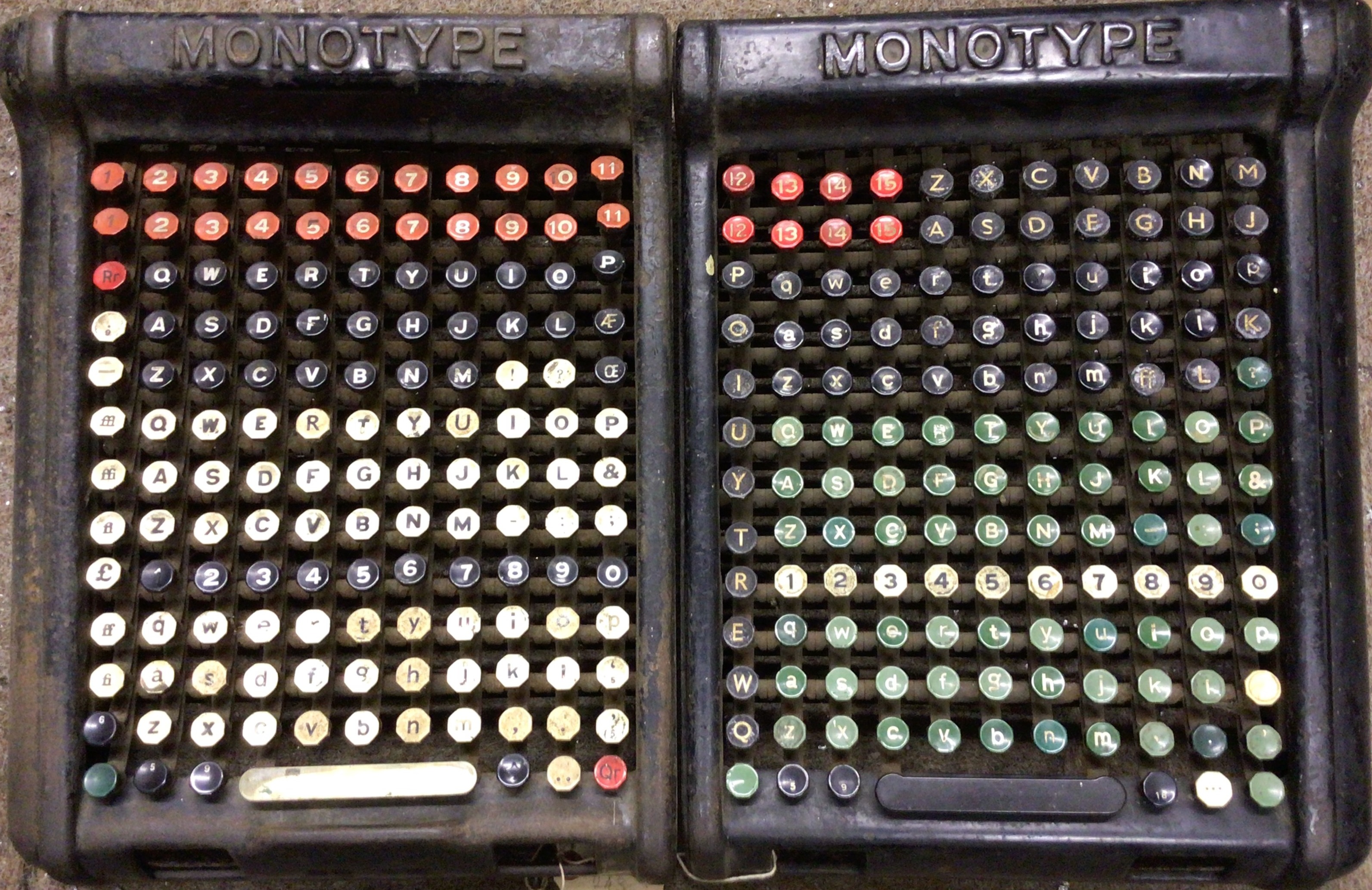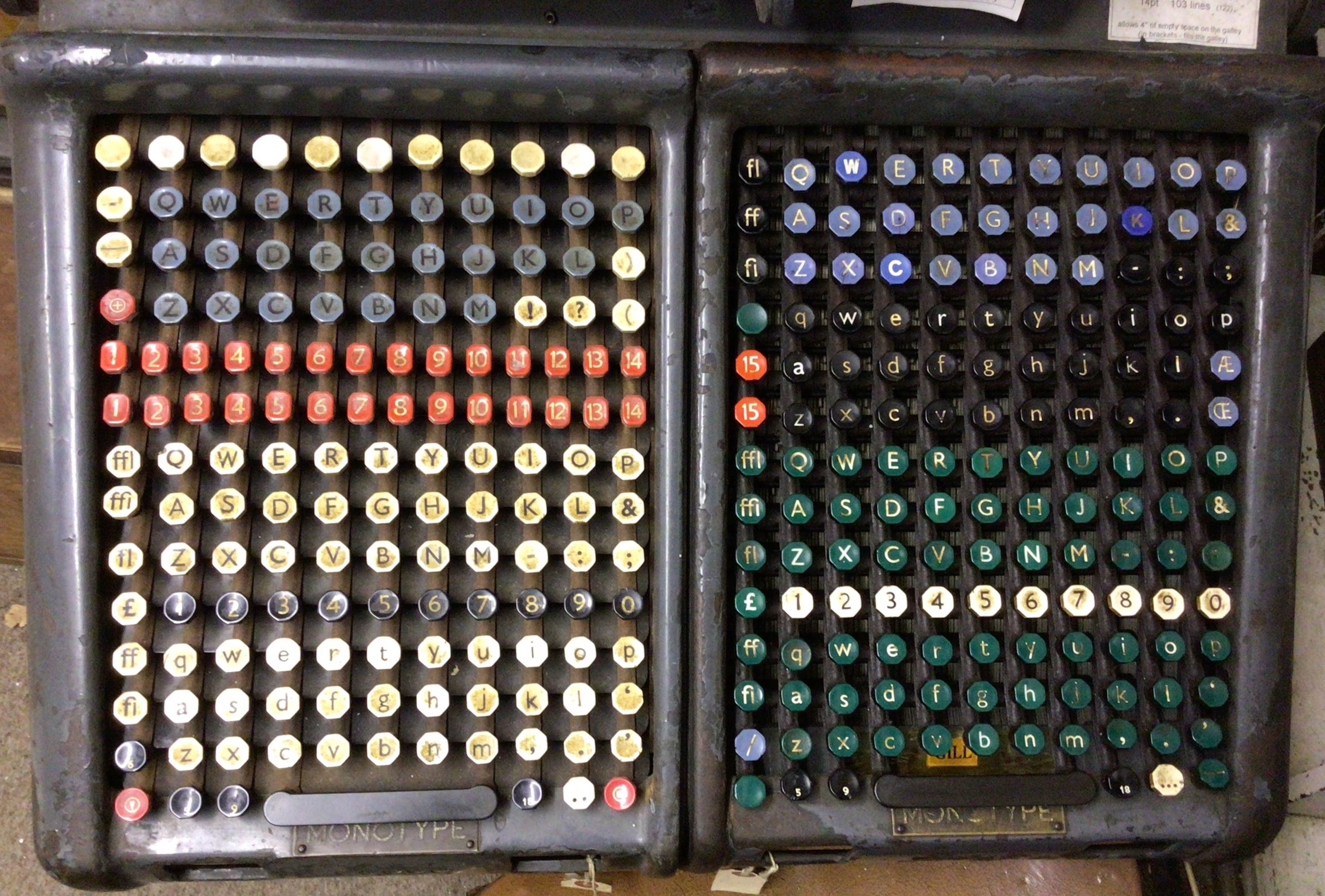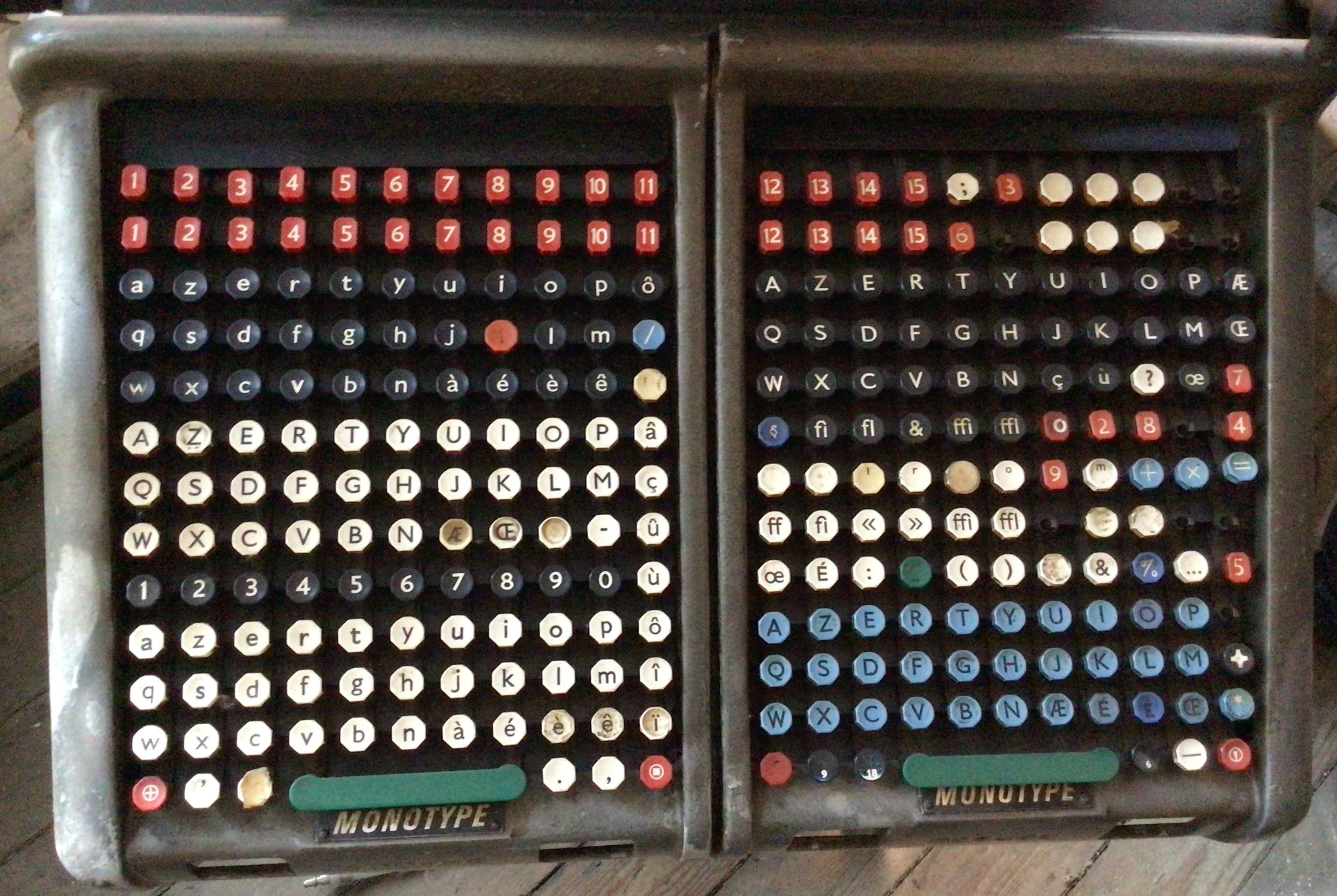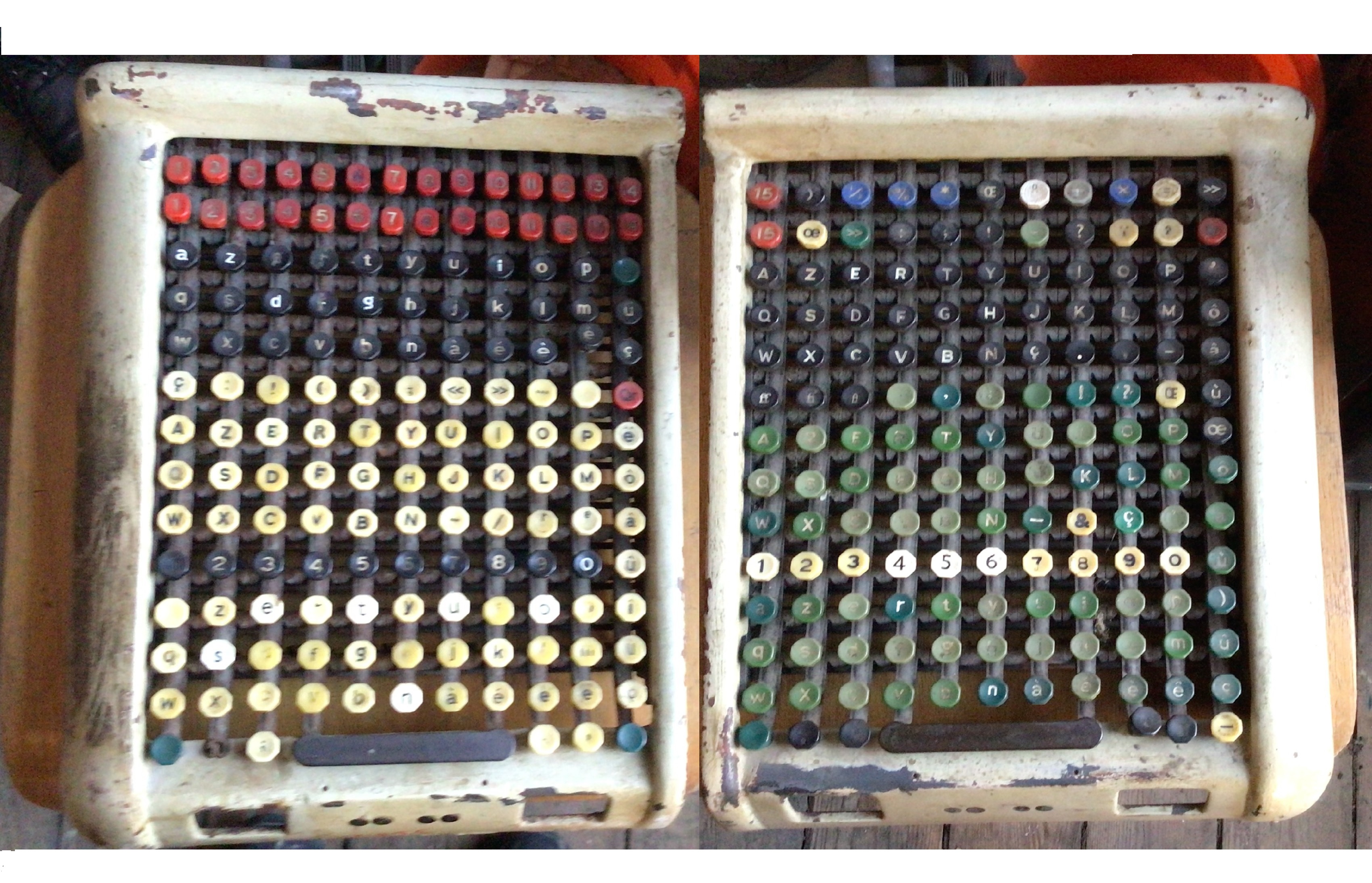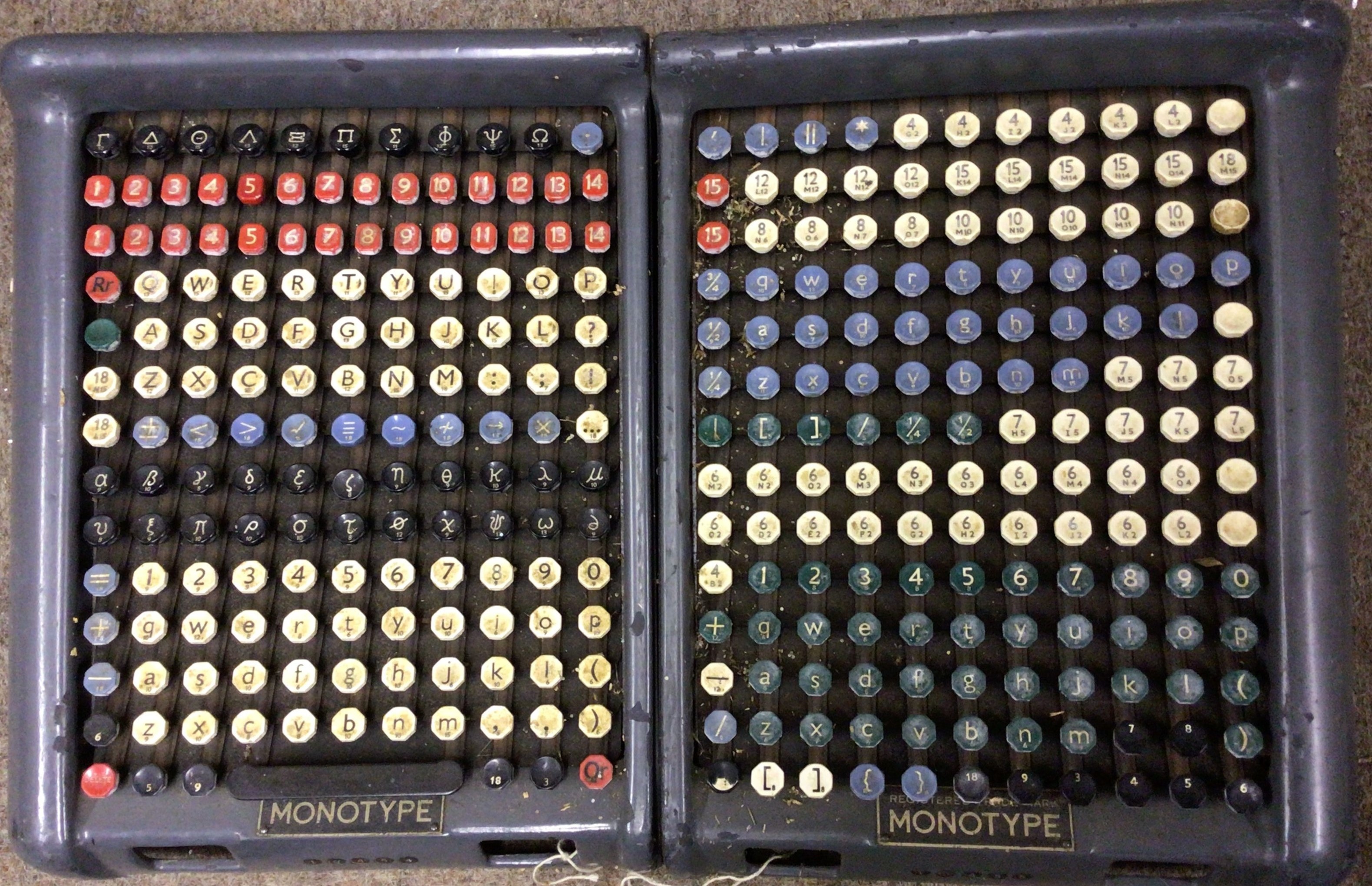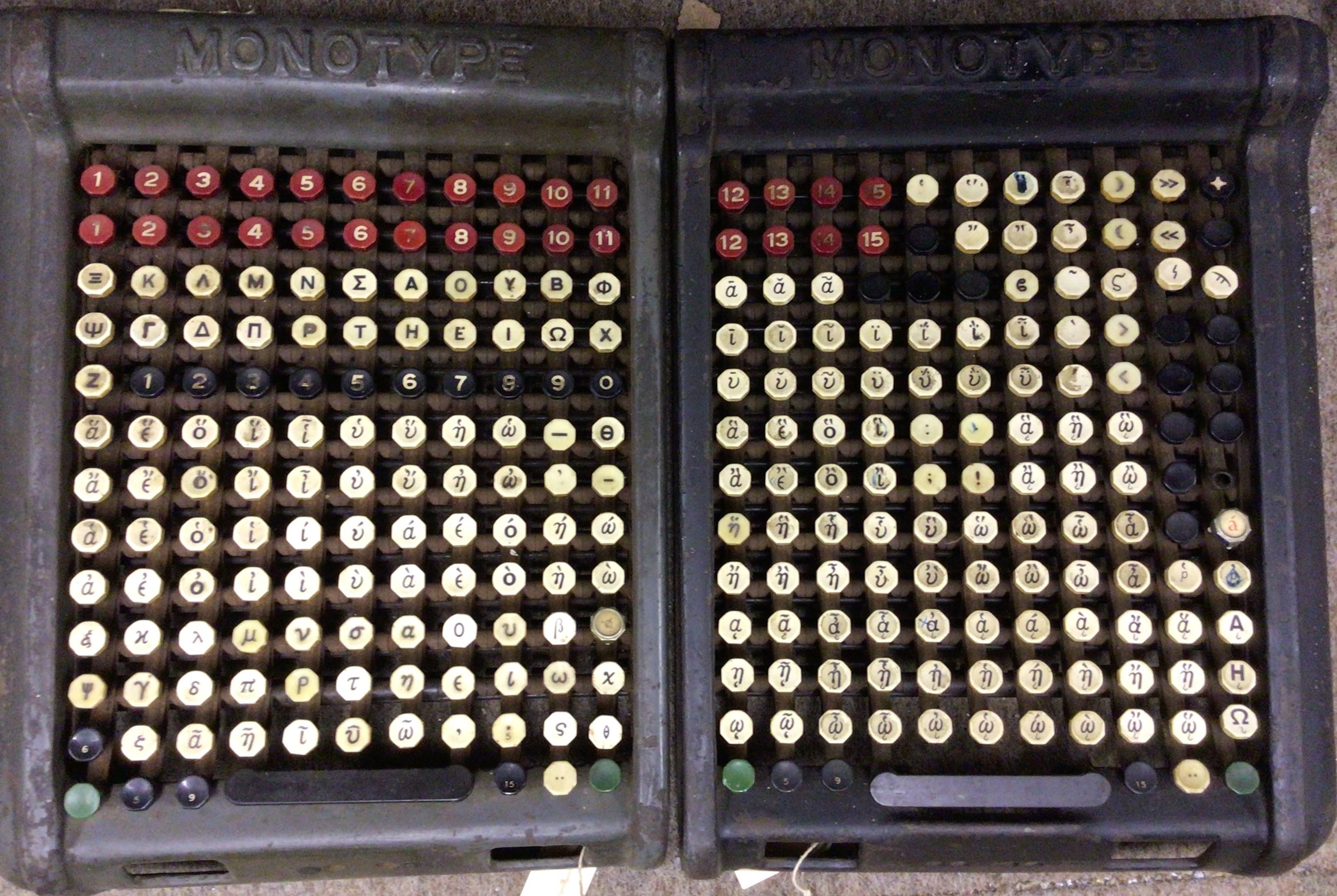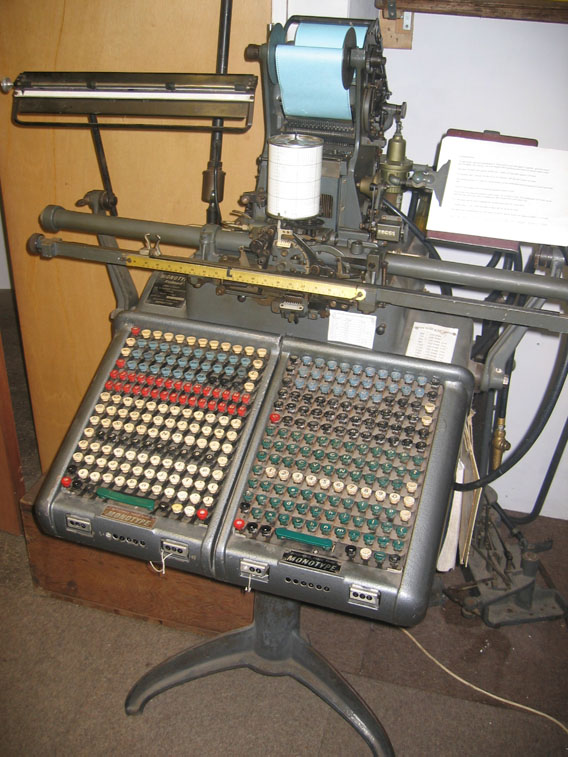
![]() | Monotype keyboards are powered by compressed air, and use a qwerty key layout usually with sufficient keys (buttons) for roman, italic, bold and small cap alphabets and figures. Whilst the layout of the keys is qwerty for English users, the letter positions can be different for other countries, e.g. an azerty layout, and also can be for non-Latin languages such as Greek, Cyrillic, Hebrew, Arabic, etc. In addition, each keybutton layout can be altered to fit in accented characters, ligatures, signs, fractions, etc. to match the requirements of a particular customer, so there are many thousand keybanks issued by Monotype. Alternatively, loose key caps can be fitted over a key when there is a temporary replacement of a character, and individual buttons can be replaced where the change is more permanent. The keybank consists of keys (buttons) that correspond to the characters in the matrix case, including ligatures, punctuation and fixed spaces but also it includes keys for the justification of variable spaces, in two rows of fifteen keys, being one row of 15 increments of 0.005 inches and one of 15 increments of 0.075 inches, and in addition there are keys for functions such as carriage return, quadder, repeater, letterspace, unit shift, etc. A common left and right hand set of button banks, as seen opposite and below, can consist of A to Z A to Z a to z ff fi fl ffi ffl 1 to 0 .,:; ‘’!?-()[]*£·/.–..%...— A to Z a to z ff fi fl ffi ffl ,:;‘’!?() A to Z & a to z ff fi fl ffi ffl 1 to 0 .,:;‘’!?-()— fixed spaces of 5 6 7 8 9 10 15 18 units The above being layout 1202, but can substitute &&£&. This assortment assumes a 16x17 matrix case and the use of unit shift and uses 264 positions in the matrix case, with 8 empty positions available for additional characters. Without unit shift (a relatively late development by Monotype), the matrix cases are smaller and the cases and keybanks have fewer characters. Note that even with unit shift, it is still not possible to have both bold and italic figures along with roman in the one arrangement, but where this happens in a 6A (alphabet) arrangement, one row of small cap keys have also been numbered 1 to 0 to accommodate this. In the 7A arrangement, if not all three versions of figures are needed, one simply uses the right hand figure row for either bold or italic. Examples of unit shift and some earlier keybanks are shown below. |
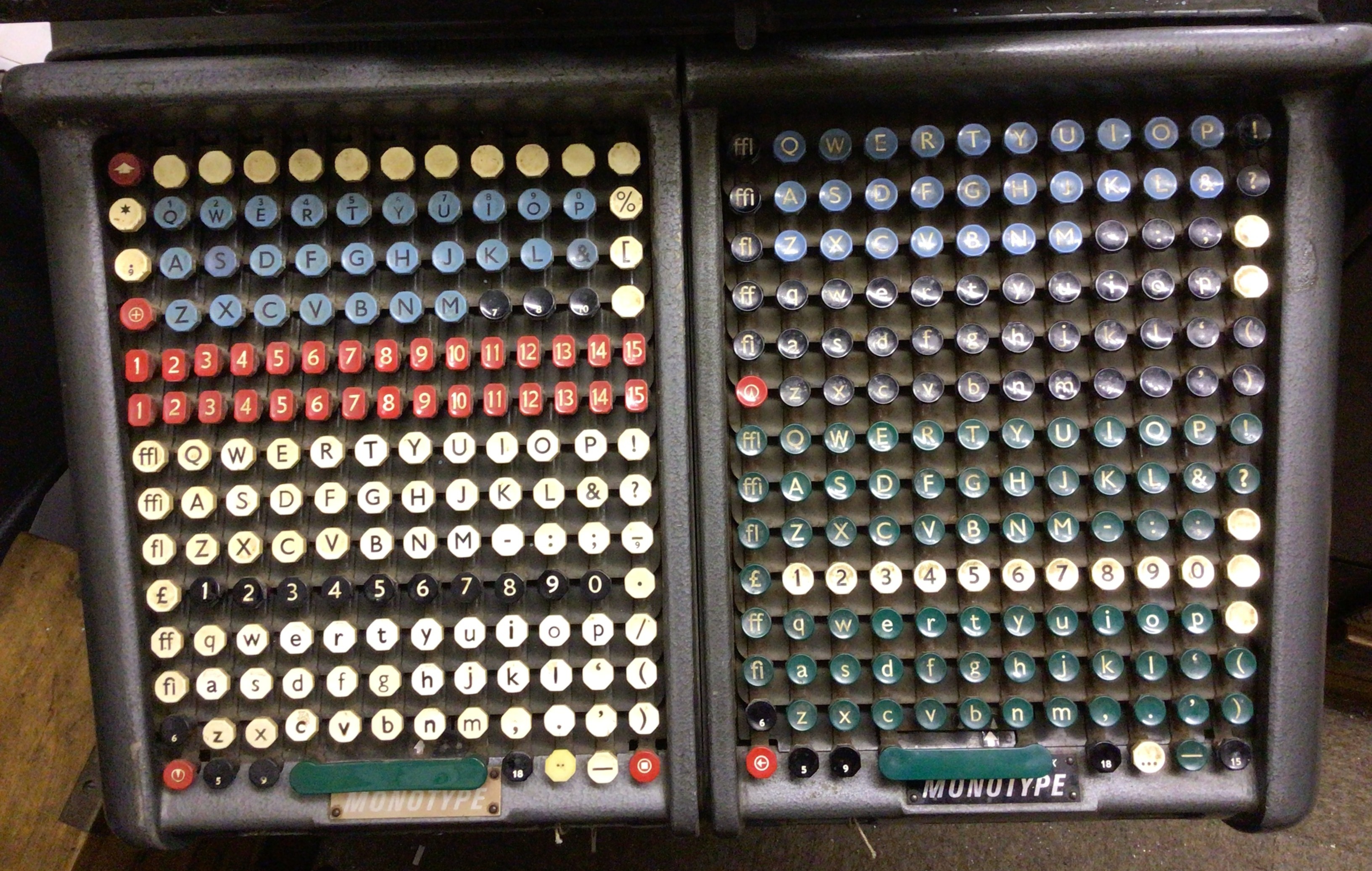
| Left Bank (3A12) spare small caps justification roman caps roman figures roman lower case | ![]() | Right Bank (4A12) Italic caps italic lower case bold caps Bold/italic figures bold lower case | ||||
| 14/12 keybanks | ||||||
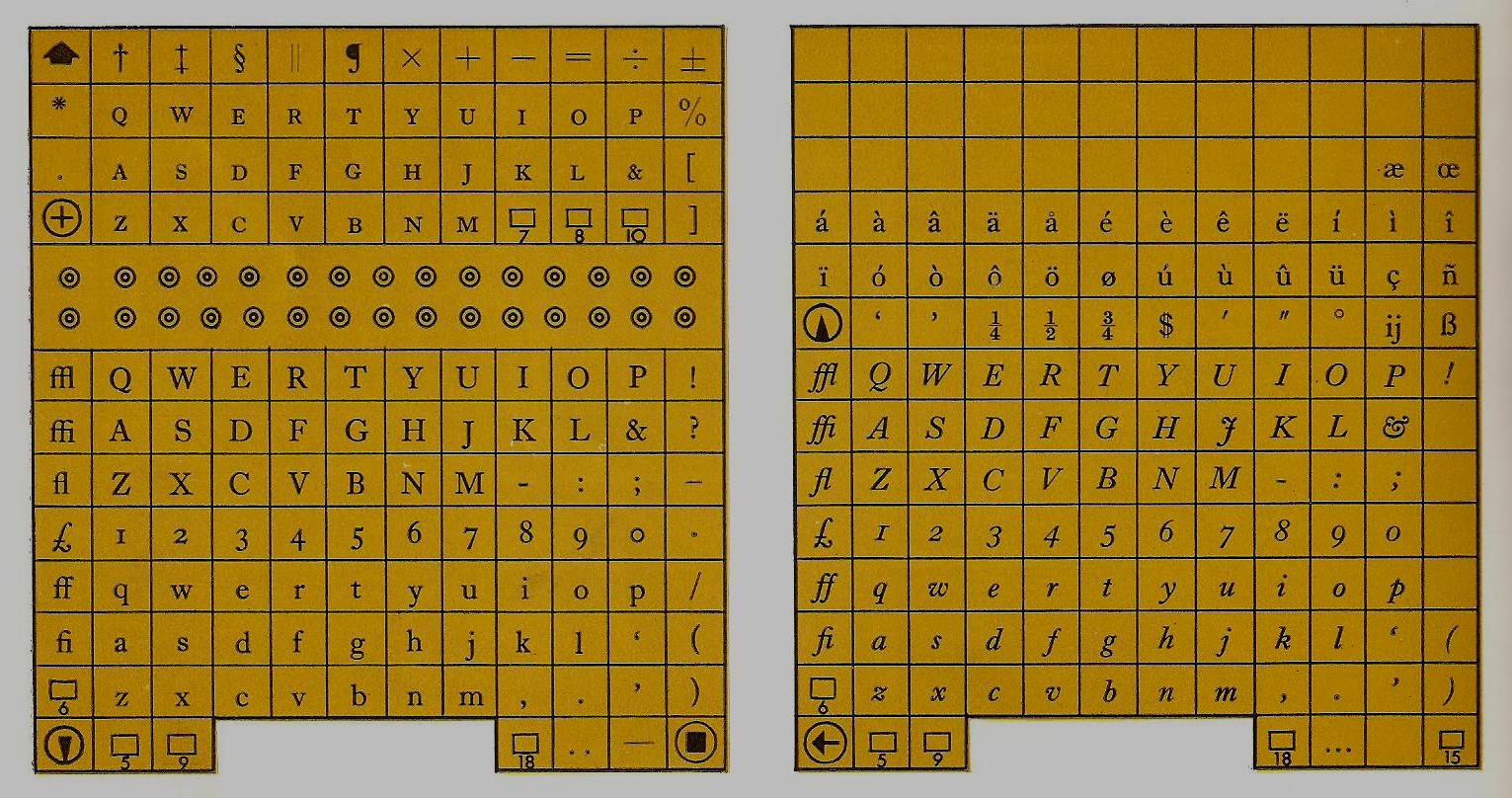
| The two standard keybanks 3A12 and 4A12 cater for a 7A (seven alphabet) matrix case arrangement, but there is an alternative right hand bank, 2A12, which caters for a 5A (five alphabet) case arrangement, e.g. where accents and fractions replace the italic keys and actual italics replace where the bold keys were. See 3A12 and 2A12 key layout | ||||||
![]() | The keybutton banks come in three sizes of key layout: 13/11 to match the basic 15x15 matrix case 14/11 to match the 15x17 matrix case 14/12 to match the 16x17 matrix case (i.e.for Unit Shift) Despite the proliferation of keybank layouts, Monotype did produce several standard ones, for example the STD3 and STD4 shown here, and the 3A12 and 4A12, shown above. | ![]() |
| 13/11 keybanks | 14/11 keybanks STD3 and STD4 | |
![]() | ![]() | |
| 13/11 azerty keybanks | 14/11 azerty keybanks | |
![]() | ![]() | |
| 14/11 Maths keybanks | 13/11 Greek keybanks |